Love all God's creatures
The Rime of the Ancient MarinerThe rule “Love all God's creatures” is the moral centre of the Ancient Mariner’s final address: true prayer depends on loving every creature, great and small, because all are made and loved by God. Its force comes from the poem’s movement from the Mariner’s inability to pray toward renewed devotion, and from his insistence that the lesson be carried beyond his own ordeal to the Wedding-Guest.
The Rule in the Mariner’s Farewell
The Ancient Mariner delivers the rule as he takes leave of the Wedding-Guest. He first says that one prays well by loving well, naming “man and bird and beast”; he then sharpens the claim into its superlative form: “He prayeth best, who loveth best / All things both great and small.” The progression extends the obligation beyond human relationships. No creature is excluded by its size or kind, and prayer’s highest expression lies in the breadth of care it embodies.
The final lines ground this ethic in divine creation: God made and loves all things. The appeal is therefore not simply to kindness as a private preference. The Mariner presents love for living beings as a response to the Creator’s own love, joining human, animal, and divine relations in a single moral principle. The repeated movement from “well” to “best,” and from named kinds of life to “all things,” gives the farewell the shape of a compact teaching.
Prayer, Estrangement, and Renewal
The rule gains weight from the Mariner’s earlier estrangement from prayer. After looking at the dead men on the rotting deck, he tries to pray, but a “wicked whisper” intervenes before prayer can rise. His failure is not merely a lack of words: the prayerful relation to the world has become inaccessible to him. Against that moment, the closing teaching identifies love for living things as inseparable from the capacity to pray well.
The poem also associates the restoration of prayer with grace. At the opening of Part the Fifth, the Mariner praises the gentle sleep sent by Mary Queen, which “slid into my soul.” The closing rule does not erase the supernatural dimension of that recovery, but gives it an ethical direction: prayer is expressed through love extending to all creation. The poem thus connects spiritual renewal not to human beings alone, but to regard for other forms of life.
The Mariner’s Ordeal as Moral Context
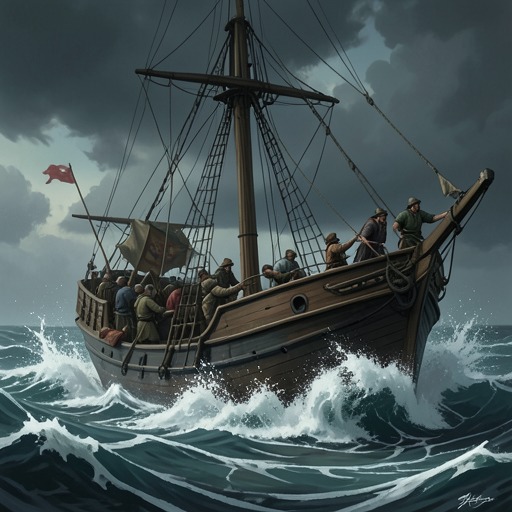
The farewell’s universal claim stands against scenes in which the Mariner’s world contracts into isolation and hostility. In the icebound south, mist, snow, and mast-high ice surround the ship; ice lies everywhere, cracking and roaring around the sailors. Later, under a “hot and copper sky” with the bloody Sun overhead, the Mariner describes a sea that offers no relief. Alone on the wide sea, he sees the dead crew and cannot pray. These contrasting environments make the rule’s reach striking: the lesson emerges from a voyage marked by elemental extremity, not from a settled, sheltered world.
The Mariner’s suffering is also made into a continuing burden. He says that for seven days and seven nights he saw the curse and yet could not die. The closing appeal does not present love as a convenient escape from that history; it converts the history into instruction addressed to another person. The Wedding-Guest is explicitly the recipient of the farewell, so the rule belongs both to the Mariner’s hard-won account and to the transmission of that account beyond the ship and its dead.
Significance and Form
The poem’s closing moral gathers its religious language into a practical relation between prayer and conduct. The direct statement that God made and loves all things supplies the reason for the rule, while the inclusive sequence of man, bird, beast, and things great and small makes its scope unmistakable. The result is less a general commendation of piety than a measure of it: devotion is fullest when it includes the whole community of creation.
The farewell also turns the poem’s narrative frame into an ethical handoff. The Ancient Mariner speaks to the Wedding-Guest, and the Wedding-Guest is the named hearer of the lesson; the poem’s final teaching therefore arrives through a survivor compelled to tell what happened to him. Its closing emphasis is not on the voyage’s spectacle alone, but on what the hearer is asked to learn from it: love for all that God made and loves.